Project
The College Pays des Sorgues comes from a 1984 building initially designed for 400 pupils, later modified through several extension campaigns and partial technical upgrades. By 2016, it no longer met the Vaucluse departmental standards, leading to a winning competition proposal for a broader reorganization of the college.
Architectural Idea
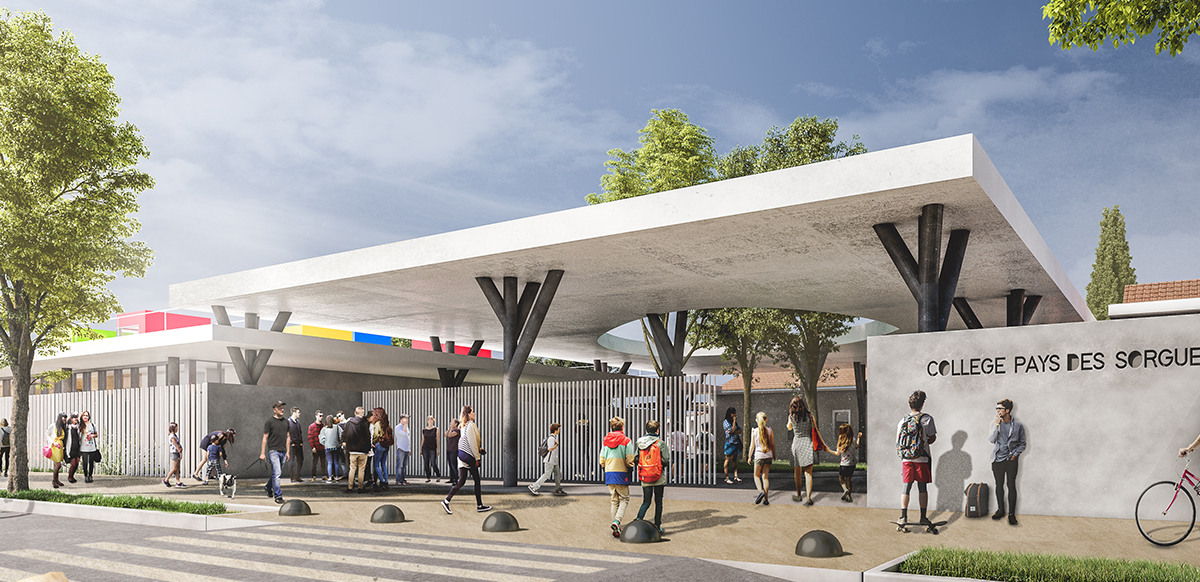
The project aimed to go beyond the strict programme by reinforcing the identity of the institution while making it more functional and economical. A new extension along the Route d Orange creates a recognizable urban frontage, stages the entrance forecourt, and strengthens the image of the college as a major public facility.
System Challenge
The existing site suffered from a weak public presence, unclear recreation spaces, obsolete catering areas, poor internal flows, and insufficient parking connections. Surveillance was difficult, entrances were poorly marked, and several services needed to be reorganized to improve day-to-day use.
Method
The proposal reorganized the college around a single student entrance and a protected forecourt that articulates circulation, separates public space from teaching areas, and simplifies supervision. The demolition of the former multipurpose block clarified the courtyard, while the restructuring of the north wing regrouped services and improved internal movement through a rational and legible spatial layout.
Impact
The result is a more identifiable, functional, and economical school environment. The project improves student flows, visual control, and service distribution while integrating durable construction principles, climate-responsive architecture, and lower-maintenance technical systems. Coordination between new build, rehabilitation, and exterior spaces becomes part of one coherent campus logic.
Why It Matters
Le Thor demonstrates how institutional architecture can combine symbolic clarity with operational efficiency. Identity, supervision, environmental performance, and circulation were treated as one design system, producing an architecture where form follows function without losing civic presence.